

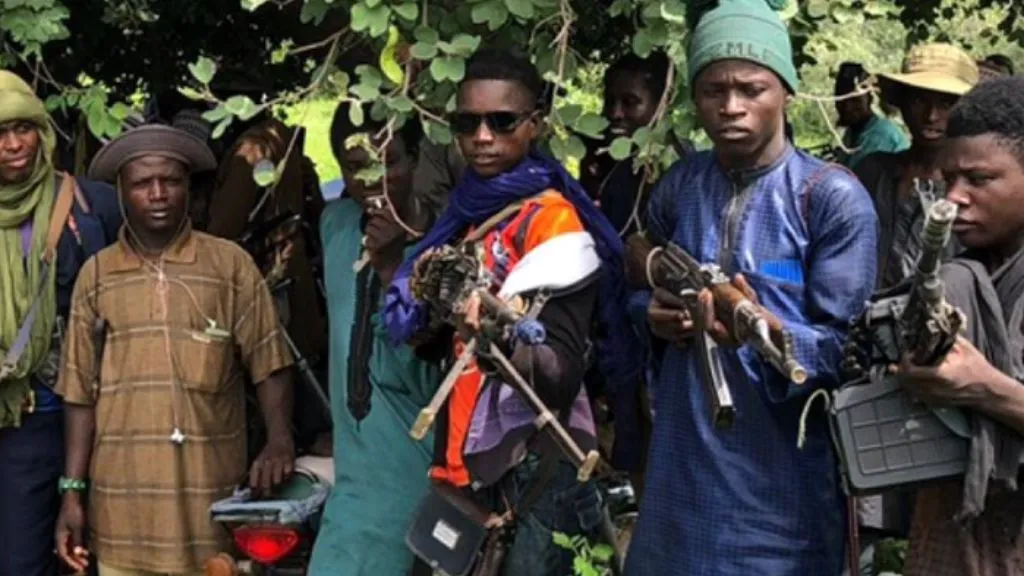
Nigerians have spent ₦2.23 trillion as ransom to kidnappers in twelve months, according to National Bureau of Statistics (NBS) which says said the payments were made between May 2023 and April 2024.

According to the NBS’s latest Crime Experience and Security Perception Survey report published on Tuesday, 65 per cent of households affected by kidnapping paid ransoms for the release of their loved ones from the abductors’ den.
“The average amount paid as ransom was ₦2,670,693, with an estimated total ransom of ₦2,231,772,563,507 paid within the reference period,” the NBS report read.
It said kidnapping incidence was estimated at 2,235,954 nationally with results showing that rural areas (1,668,104) recorded more kidnappings than urban areas (567,850).
“Further analysis by zones revealed that North-West had the highest cases (1,420,307), followed by North-Central (317,837), while the least was recorded in South-East (110,432),” it said.
Of the households that experienced kidnapping, the survey indicated that 80.5 reported it to the police.
“The South-South zone had the highest reporting rate at 100 percent, followed by North-Central at 89.6 percent, while North-West was least reported at 73.9 percent,” the report noted. “Disaggregated by place of residence, urban areas recorded 87.1 percent compared to 77.3 percent in rural areas.”
A further analysis of the report showed that some of the abducted persons were killed, while others were released.
It showed that of the reported cases of kidnapping, 82.1 percent were released, 12.8 percent were killed and 3.3 percent were still in captivity.
The study indicated that “About 91 percent of kidnapping incidents were done for ransom in the form of money, goods, or other benefits.
“Also, 2.4 percent of cases were attributed to political, criminal, or terrorist objectives, while 2.1 percent were linked to personal or family disputes. Custody disputes accounted for 0.5 percent of cases”.
On the overall crime rate in Nigeria, the NBS survey suggested that North-West region had the highest incidence of crime. There were 14.4 million reported cases in the region. This was followed by the North-Central region with 8.8 million.
However, the South-East region recorded the lowest number of reported crimes. It had 6.18 million incidents in the period under review.
Stories about abductions are rife in some parts of Nigeria. From mass abductions in schools to the killing of abductees, the crime seems to have become a business venture for gangs.
Despite government reassurance and that of security agencies, the situation, experts believe, has not been minimally reduced.
Meanwhile, several northern states have resorted to vigilante squads and private security personnel to complement the Federal Government’s effort in the fight against banditry, terrorism and kidnapping.
The Kano State Government recruited no fewer than 2,500 security personnel to enhance security across the state.
The security personnel were trained at the state’s Corporate Security Training Institute located in Gabasawa, headquarters of Gabasawa Local Government Area of the state.
A state official, who spoke to The PUNCH on condition of anonymity because he was not authorised to speak on the matter, said the initiative was aimed at boosting job opportunities for youth and strengthening the state’s security architecture.
“The present administration under the leadership of Governor Abba Kabir Yusuf recruited no fewer than 2,500 private security personnel recently as part of efforts to enhance security in the state,” he said.
According to him, the trained personnel were deployed to ministries, departments and agencies to bolster existing security structures and enhance overall safety.
“The initiative is in fulfillment of one of the present administration’s campaign promises of providing job opportunities for the youths and strengthening the security architecture of the state as revealed in a statement issued by the Director General, Media and Publicity to the governor, Sanusi Dawakin Tofa, after commencement of the training,” the official said.
In January, Governor Dauda Lawal of Zamfara State unveiled the 3969 members of the State Community Protection Guards set up by his administration to tackle the insecurity challenges affecting the state.
Speaking during the presentation of the security guards in Gusau, Governor Lawal said, his administration was poised to bring an end to banditry in the state.
“I am compelled to recruit the community Protection Guards considering the persistent banditry in the state, which has been claiming the lives of our people and depriving the farmers an opportunity to go to their farms.
“I want to use this opportunity to appeal to our people, particularly those living in rural communities to please cooperate with them in order to effectively fight all forms of criminal activities.”
Also, the Kogi State Government said it engaged 3, 000 personnel across the 21 Local Government Areas of the state to fight banditry and other crimes in the last one year.
The Special Adviser to Governor Usman Ododo on Media, Ismail Isah, said, “We have employed over 3000 men in the state vigilante service and local hunters across the 21 Local Government Areas in the last one year. This is in addition to the number inherited from the previous administration” he said.
The Bauchi State Government also confirmed leveraging on lawfully registered vigilante groups in fighting banditry and terrorism in the state.
The Bauchi State Commissioner for Internal Security, Abdulhamid Bununu, made this known on Tuesday.
“The groups work under the coordination of the Bauchi State Commissioner of Police. They have been very helpful and work alongside the police whenever we have to raid terrorists hideouts like the Lame Burra forest, where bandits from Zamfara sometimes cross the border.”