

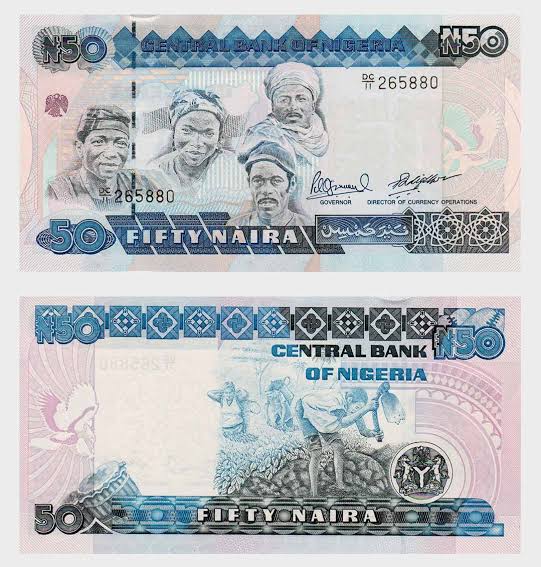
The Fifty (50) Naira note was introduced into Nigeria’s economy during the administration of General Ibrahim Badamosi Babangida in 1991. At its inception, the note generated immense excitement and curiosity among Nigerians. People were eager to get their hands on two or three of these notes, not just for transactional purposes, but as a prized possession.

I vividly recall receiving one of these notes as a gift from my elder brother living in Lagos, which I treasured like a precious gem. Despite being hungry, I hesitated to spend it, uncertain when another opportunity to possess this denomination would arise. Among my friends, owning a Fifty Naira note became a symbol of pride, with many longing to be its custodian.
Upon its introduction, the 50 Naira note attracted widespread acclaim, including praises from notable musicians like King Wasiu Ayinde Marshall (K1) and Alhaji Rasheed Ayinde Merenge. These music legends celebrated the note’s uniqueness in their songs, recognising its significance as:
1. The highest denomination at the time, symbolising economic growth and stability.
2. The first Naira note featuring four unknown Nigerians, representing the country’s diversity and inclusivity.
The four individuals depicted on the front side of the note – a Hausa man, an Igbo man, a Yoruba man, and a woman at the centre – embody Nigeria’s major ethnic groups and the female as the mother of all. This deliberate design choice underscores the importance of unity in diversity, celebrating the everyday people who make up the fabric of the nation.
The reverse side of the note depicts a traditional agricultural scene, highlighting agriculture’s vital role in Nigeria’s economy. This design promotes appreciation for Nigeria’s agricultural roots and encourages support for the sector’s development.
Interestingly, for over twenty years, the 50 Naira note operated in the background, its existence barely acknowledged. However, recent economic events have thrust it into the spotlight. The transportation sector’s sudden increase in fares, exceeding 100%, has left commuters scrambling for a reprieve.
In this context, the 50 Naira note has become a coveted commodity. Transporters, now demanding 200 Naira for journeys previously costing 100 Naira, are beneficiaries of the note’s scarcity. Commuters, on the other hand, bear the brunt, forced to pay the inflated fare due to the unavailability of 50 Naira change. This disparity highlights the note’s significance:
The scarcity of 50 Naira notes has reduced daily sales of some transporters by 30%. Passengers are unwilling to pay the increased fare making it difficult for transport operators to make ends meet.
As you read this article, I’m certain that every reader from my generation will begin to relate their own experiences – moments when the 50 Naira note saved them from paying exorbitant transportation costs. Memories of scrambling for change, of relieved smiles when a transporter accepted 50 Naira, or of proudly breaking into a newly acquired 50 Naira note will resurface.
The 50 Naira note’s impact extends beyond economic transactions; it’s a nostalgic trigger, evoking memories of resilience and resourcefulness. Beyond the transportation sector, the 50 Naira note’s scarcity has far-reaching consequences. It highlights the fragility of Nigeria’s economy, where a seemingly minor issue can have significant ripple effects.
Moreover, the 50 Naira note has become a symbol of economic resilience, demonstrating the adaptability of Nigerians. Its widespread acceptance and usage attest to its importance in everyday transactions.
To mitigate the effects of the scarcity, the Central Bank of Nigeria (CBN) must increase the circulation of 50 Naira notes. Encouraging alternative payment methods, such as digital transactions, can also alleviate the pressure. Furthermore, economic policies addressing inflation and price stability should be prioritised.
In my conclusion, the 50 Naira note’s significance extends beyond its face value. Its scarcity has exposed the vulnerabilities of Nigeria’s economy and underscored the need for proactive measures to ensure economic stability. As the economy continues to evolve, the importance of this denomination will only continue to grow.
God bless Nigeria!